About
A bit of history
The history of Old Cottonian Association has been blurred in the mists of time; specially since no formal attempt has been made to record the history. This great and oldest public school in India, has produced the highest decorated officer amongst all the armies of the world, heads of state, ambassadors, judges, Defence and para military officers, ministers and politicians.
In mid 1918, during World War I, the school numbers had fallen drastically and many of the staff had been mobilised for war. Fresh staff members were not available. A controversy raged regarding the future of Bishop Cotton School (BCS). It was decided to close BCS and turn it into a preparatory school for Army officers’ children. The three Lawrence Schools at Ooty, Sanawar and Gora Gali were set up for the children of other ranks. No school in India catered to the Army officers’ children.
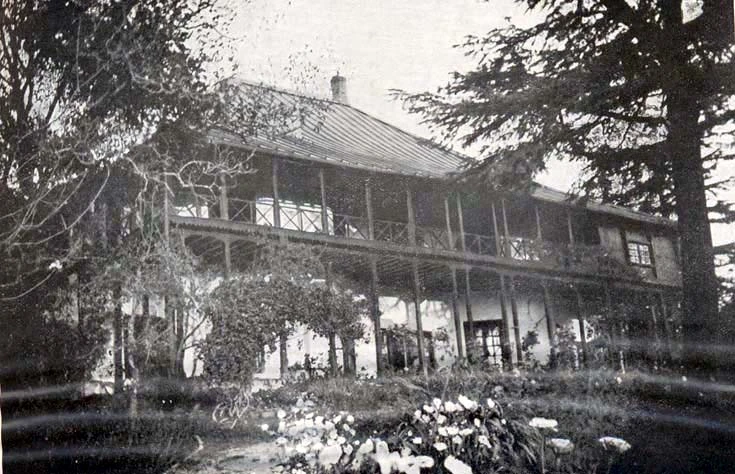
Pictured above is the original school, at Jutogh in the 1930’s
HE Lord Chelmsford and HE Sir Edward Maclagan, both from Winchester College, founded 1387, one of the oldest Public Schools in England, went out of their way to help the school. The army had requisitioned the services of Rev FR Gillespy, MA, FRGS. After it was decided to continue BCS , Rev FR Gillespy was requested to be its Headmaster. He required 50 boys to reopen the school; only 12 were registered in Jan 1919. Rev FR Gillespy (HM 1919-22) who came from Quetta, Pakistan was able to raise the admission to 125 boys by March 1919.The proposal to convert BCS to a Defense Service Officer’s School was dropped.
On Speech Day 09 Sept 1919, Lord Chelmsford said, regarding the pleasing aspect of the attitude of the old boys “…they were, one and all, up in arms against the proposed change. They objected most strenuously to their old school being used for a purpose foreign to its tradition. And this, I think was the bright spot in the controversy. By their actions the old boys showed that, though they had left it, they still loved and honoured the old school, were mindful of its tradition and jealous of its future. This is the right spirit. A school stands or falls by the attitude of its old boys.”
The other major contribution by the OCs was in 1913, when 101 OCs presented the most beautiful “The Good Shepherd” , stained glass window to the school chapel for the 50th Jubilee. Recently the old boys have contributed about Rs. 10 million.
On the first Founder Day,1878 on 27 July, 28 old boys dined together in the school hall at the high table. When the first wave of reminiscences, and torrent of inquiries about boys who had passed out had somewhat subsided, some sense of contrition began to awaken. The diners felt that though their lives were spent in such close proximity to their school, they had been guilty of neglecting it. Could this have been our founding date?
Views were also interchanged as to the possibility of maintaining touch with the school, which this dinner had revived. Hopes were expressed of other such dinners to follow and the Old boys Union may be said to have been born before the last echoes of Old Lang Syne had died away. But much had to be done before the scheme could assume practical shape. Towards the close of 1909, at the initiative of the school, a number of old boys dined together in the School Hall.
Suffice it to say that on 13th May 1910, a meeting of Old boys was held in the Freemasons’ Hall, Simla, through the kindness of Ned Wilsey and his brother Masons, seventeen Old Cottonians were present and as the pioneers of a movement are always entitled to certain amount of credit , the names of the first old boys to join the association are given at Appx B in the order in which they signed the roll of the association, with the years they attended BCS. The OCA was founded by Cecil William Kirkpatrick, OBE, Asst. Sec, Govt. of India. He expired on 20 Aug 1939. He was also the first secretary and had 120 members.
Having formed the nucleus of the Association, the task had to be faced of discovering and communicating with the numerous old boys scattered more or less over the world. Some measure of success resulted for, by 01 May, 1911 (less than 12 months after the movement had been initiated ), the numbers on the rolls had risen from 17 to 73; by 01 May , 1913 to 84 and in October 1913 to 101.
In 1934, 4 chapters of OCA existed with the Governor of Punjab as the Patron:
OCA (India) – Lahore, Calcutta & Peshawar
OCA (UK) – London
At independence / partition in 1947, FM Brown (C 1934-40, staff 1942-47 and 1950-61), officiating Headmaster 1954-55, wrote that there were only 11 life members on our ledger and by 1959 there were 200. Currently, there are approximately 2500 members world-wide. The Delhi branch opened in 1952 with Raja Vir Bhadra Singh( I 1947-51) as the first secretary and currently the Chief Minister of Himachal Pradesh. The Bombay, Chandigarh and Himachal Chapters were launched in 1956, 1961 and 2005 respectively.
For the future a complete roll of BCS boys from 1863 to the present day has been compiled from school records and, with the help of this, it is hoped it will be possible to trace many old boys whose whereabouts are at present unknown and to enlist some of them. The oldest photograph of an OCA gathering was taken in 1913 and is at Appendix N.
The aim of the Association, as described in its rules are: to establish a bond of union among old boys and present boys to meet each other and for this purpose annual dinners and dances at the school have been instituted. The projected football match are further attempts to accomplish the above objects followed by Tennis, Cricket, Squash etc.
OCA (UK) Estd 1928
OCA (UK) was established in 1928. Interestingly, the then HM, Rev J.R. Peacey(HM 1927-35) wrote to “Lumboo” Raymond E Wood(R 20-22) to “rustle up” some OCs in UK for a get together to meet the HM while in London. Lumboo gathered 20-30 boys thus the OCA(UK) was established. Others who did yeoman service were Dick Clarence Bayliss(C 18-22) Chairman OCA(UK) from 1960 to 1997. Lumboo R.E Wood was the Secretary of the OCA(UK) for 43 years from 1928-70. Peter Stringer(L 43-47) is the current Secretary of OC(UK) and is like Lumboo “a totally dedicated Secretary”, N.G.P Niblett(R 40-47) is our current Chairman of OC(UK).
P W C Curtis(L 21-27) was the joint founder of the newsletter called “The Mitre” and he printed the very first issue from London on a home made duplicator in the mid thirties. The OC wives ensured that during the world war II when their husbands were serving in the front, the newsletter continued to function. Letters were written from “somewhere up Front” or “Hell-Hole” and heavily censored!
The objectives of the Association were set out in its rules. First, it was sought to ‘establish a bond of union among Old Boys and present boys to meet each other and for this purpose annual dinners and dances at the School’ were instituted. Second, the Association wanted to put an end to the stigma the bureaucratic circle attached with an Indian education. Third, the Association promised, “ Should anything arise to occasion a demand for the active services of its Old Boys the School has the satisfaction of knowing a number of them are to hand, not only willing but pledged, to assist by every means in their power.”
Almost as if giving visible expression to their pledge, the Old Boys presented the School’s Chapel with the stained glass window depicting the Good Shepherd. This was installed on 19 October 1915.
The Old Cottonians Association completed 100 years in 2010.
Name
Years at BCS
E.O. Wilsey
1863 - 1867
W.J.Crayden
1863 – 1866
W.Cotton
1876 – 1884
T.Archibald Brooks
1876 – 1877
S.A.Blaker
1881 – 1883
W.G. Dollman
1882 – 1890
C.Davis
1882 – 1886
Felix von Goldstein
1884 – 1892
C.W.Kirkpatrick
1884 – 1888
E.A.Reid
1887 – 1891
W.I.Tilden
1887 – 1891
D.A.Clarke
1891 – 1896
Frank I.Tellery
1893 – 1895
A.D.Grindal
1895 – 1899
G.T.Wright
1898 – 1900
G.A.Heron
1902 – 1903
A.Farrar Brooks
1908 – 1910
The History Of The Old Cottonians Association
The OCA was officially started on 13th May 1910 when 17 Old Cottonians assembled in the Freemason’s Hall in Simla. However, it is interesting to note that the first gathering of OC’s was in 1878 when 28 old Cottonians attended the First Founder’s Day function ever to be celebrated. This was held on the 27th of July as 28th fell on a Sunday. These OC’s sat at the High Table for the meal that followed the function.
E.O. Wisley, the senior-most, had organised the meeting and was the first to sign the Roll of Association. With these seventeen acting as the core, the task was now to find and communicate with the numerous old boys who lay scattered across the world – England, Canada, Japan, China, New Guinea and of course, India. In under a year, the Seventeen had become 73. By 1 May 1913, there were eighty-four members and this rose to 101 by October that year.